How Arabic Calligraphy Became an Important Part of Islamic Art?
Whenever you walk into a mosque, a gallery of Islamic art, or a religious ceramics shop and you’ll notice that the same words are everywhere. Inscriptions adorn domes, flow across tiled walls, and trace the edges of polished brass trays. If you grew up with Western art, where writing is usually a caption, that can feel surprising.
So how did Arabic script go from a practical way of recording language to the most prestigious form of Islamic art? The answer involves scripture, geometry, court politics, and a great deal of patient practice with a reed pen.
Why Arabic Calligraphy became part of Islam?
Arabic calligraphy became central to Islamic art because the Qur’an was revealed in Arabic, so writing it beautifully and accurately became a sacred task. Calligraphers then developed proportional rules that turned the script into a refined art, and artists carried it onto buildings, ceramics, textiles, metalwork, and coins.
A Script Tied to the Qur’an
The Metropolitan Museum of Art describes calligraphy as the most highly regarded and fundamental element of Islamic art, and it connects that status to the fact that the Qur’an was revealed in Arabic, a script that offered plenty of room for ornamental development. You can read more about it on Met Museum.
The V&A notes that Muslims regard the Qur’an as the literal Word of God, so presenting it with precision and clarity mattered immensly. For most of Islamic history, the text was preserved in handwritten manuscripts. A scribe wasn’t just copying words but he was crafting and handling something sacred.
That seriousness shaped how calligraphy developed. Early Qur’an manuscripts used a distinctive format, and later, more fluid scripts replaced the older hands by the 13th century. Even when mechanical printing was permitted in the late 19th century, the V&A points out that the text to be printed was still written out by a scribe working in the traditional way. The pen remained the authority.
Why Calligraphy and Not Pictures?
You’ll often hear that calligraphy flourished because Islamic art avoids depicting people. There’s something to that, especially in religious settings like mosques, where figural images were generally avoided. But it’s an incomplete explanation. Courts in Persia, Mughal India, and the Ottoman world produced rich traditions of figurative manuscript painting.
A better way to see it is that calligraphy was never a substitute for images. It was the art form closest to the God, and artists saw how much visual potential lay inside the letters themselves. They observed that a single letter can grow into a decorative knot, and an entire word can look like a cluster of brushstrokes.
From Early Kufic to Measured Beauty
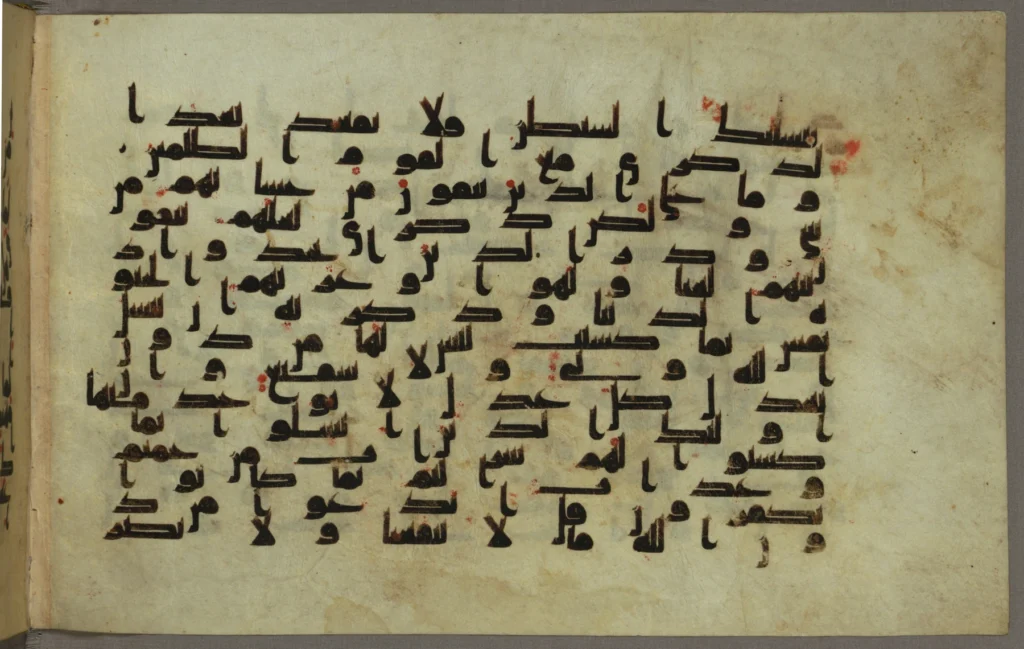
Early Qur’ans were often written in angular scripts, with Kufic being the best-known example. These can be striking, with their bold, horizontal rhythm, but they were not always easy to read. As Islamic empires grew and book production expanded, scribes wanted scripts that were both beautiful and consistent.
Ibn Muqla and the Proportioned Script
The turning point is traditionally credited to Ibn Muqla, an Abbasid vizier and calligrapher active in 10th century Baghdad. He is said to have created a system of proportions based on the diamond-shaped dot made when a reed pen touches the page, with each letter’s height and width set as a number of those units. This approach is known as al-khatt al-mansub, or proportioned script.
None of his original manuscripts survive, so much of what we know comes through later calligraphers who built on his ideas. You can read more about this at Smart History’s post.
Ibn al-Bawwab and Yaqut al-Musta’simi
Ibn al-Bawwab, working in Baghdad around the year 1000, is remembered for giving the proportioned scripts grace and flow. His signed Qur’an, dated 1000–1001, is celebrated as an early example of a Qur’an in a cursive script rather than Kufic.
About two centuries later, Yaqut al-Musta’simi refined the system further. He is credited with cutting the reed pen at an angle, and his work helped consolidate the six classical scripts, known as the Aqlam al-Sitta or “Six Pens.” These include Thuluth and Naskh, along with Muhaqqaq, Rayhani, Tawqi’, and Riq’a.
Centuries later, Ottoman calligraphers such as Sheikh Hamdullah (1429–1520) reshaped the scripts again, making Naskh and Thuluth lighter and more precise. Check out more at Arab News.
Calligraphy on Everything
Once the script had a rigorous visual system, artists began using it far beyond books. Calligraphy appears across all art forms and materials. A few examples of what that looks like in practice.
- Architecture: It includes the engraving on mosques and tombs. One of the earliest monumental examples is the inscription inside Jerusalem’s Dome of the Rock, completed in the late 7th century.
- Ceramics and tiles: bowls, wall tiles, and mosque lamps inscribed with blessings or verses, many of which appear in the Met’s collection.
- Textiles: tiraz, inscribed textile bands associated with rulers and courts.
- Metalwork: trays, mirrors, and basins covered in lettering.
- Royal documents: the tughra, the stylized imperial monogram, such as the one made for Sultan Süleiman the Magnificent.
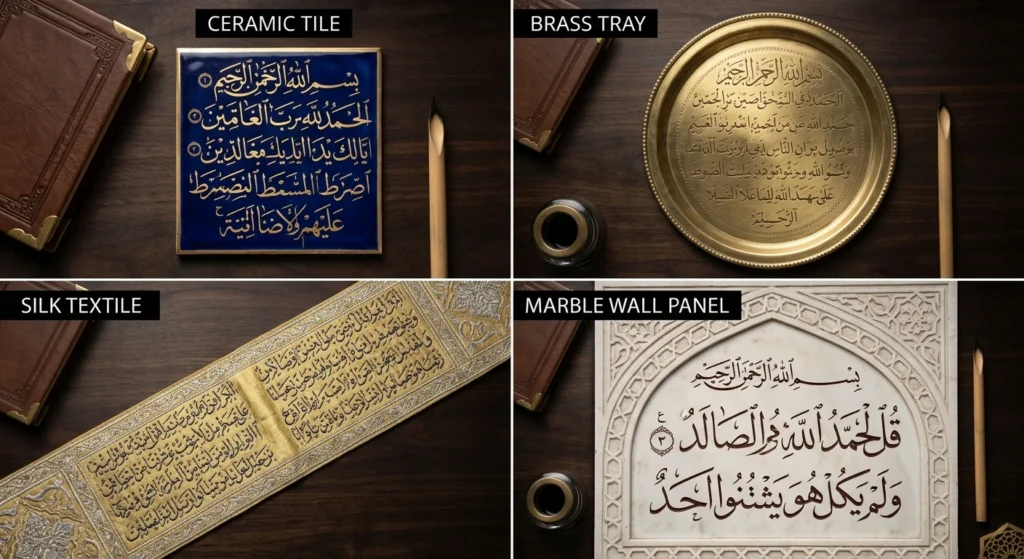
Artists also experimented with different forms and compositions. They often combined calligraphy with flowing vegetal patterns on the same surface, allowing the lettering and floral motifs to complement each other. Even when working with materials such as stone, wood, or metal, craftsmen tried to recreate the natural movement of ink on paper, giving carved designs the expressive quality of a reed pen stroke.
There was a balance to keep. In Qur’an manuscripts, frames and background patterns had to be carefully made so they didn’t interfere with the clarity of the script.
Not All of It Is Religious
It’s easy to assume every inscription is a Qur’anic verse, but that isn’t the reality. While the Qur’an explains calligraphy’s importance, inscriptions on works of art also include poems, praise for rulers, and aphorisms. For Instance, A brass tray might carry good wishes for its owner, and a ceramic bowl might hold a proverb about generosity.
Many artworks featured clear, readable inscriptions, but that didn’t mean everyone who encountered them could understand the words. Some inscriptions were also believed to carry protective or talismanic significance. In this way, calligraphy served several purposes at once. It conveyed written meaning, added beauty to an object or space, and could also represent blessings, protection, or authority.
A Quick Guide to the Major Styles
- Kufic: angular and geometric, common in early Qur’ans and architecture.
- Naskh: compact and highly readable, widely used for books and printed text.
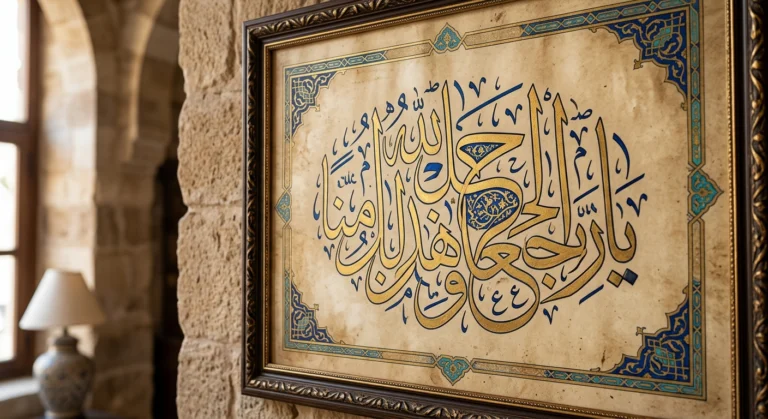
- Thuluth: large, flowing, and monumental, often used on mosques.
- Diwani: dense and rounded, associated with Ottoman court documents.
- Nastaliq: a sloping, hanging style linked to Persian and Urdu writing.
- Maghribi: open, curved forms from North Africa and al-Andalus.
If you’re curious how these look side by side, you can type any Arabic phrase into Arabic Calligraphy Creator and compare the styles directly.
Calligraphy Today
The tradition hasn’t stopped. In 2021, UNESCO added Arabic calligraphy to its list of intangible cultural heritage, recognizing it as a living practice. Contemporary artists and designers continue to build on it, from fine art canvases to logos, posters, and digital art. Arabic fonts and tools now let anyone experiment with these scripts without years of training. A tool can show you how a style looks, but the discipline of the calligrapher, the training and the sense of proportion, remains its own craft.
Final Thoughts
Arabic calligraphy became central to Islamic art through a chain of many connected reasons; reverence for the Qur’an, a script rich with visual possibility, and generations of masters who gave it order and beauty. From there it spread to nearly every place a craftsperson could reach.
To see how that tradition looks in practice, try your own name or a favorite phrase in Arabic Calligraphy Creator and compare how different scripts change its character.