History of Arabic Calligraphy: Its Styles and Meaning
By its absolute definition, Arabic Calligraphy is defined as the artistic practice of writing the Arabic script in eloquently. It is one of the oldest and honoured form of art in the history of world. In Arabic culture, calligraphy is a long preserved art that is been practiced since centuries. In the modern era, where the world has moved towards minimalism and contemporary arts, this piece of art still holds the legacy for its beauty and religious importance.
The Origin of Arabic Calligraphy
The origin of Calligraphy dates thousands of year back in the Pre-Islamic era in the Arabian continent. Back then, Arabia was home to numerous semitic languages. In the ancient Persia, around 500-600 B.C., Calligraphy was used to decorate the monuments of kings and sultans of that time. Calligraphy was considered a royal symbol for adornment.
Impact of Islam
The religion Islam holds a great credit and importance for the advent of Arabic Calligraphy. With the advent of Islam, the entire Arab Peninsula opted Arabic as their primary language which promoted the art of calligraphy. Arabic Calligraphy was considered as a symbol of spirituality and people began to learn this art for passion and preservance.
The construction of Baghdad
The construction of Baghdad city by the Abbasid Caliph was also a turning point for the art of calligraphy. With the breath-taking design of city along the banks of the Tigris River, it was a massive royal project. It was this time when he called intellectuals and artists from far off places to turn his dream into a reality. Those artists used their utmost capabilities to craft state of the art monuments and places featuring the verses of Arabic calligraphy. This art is the reason why even today, Baghdad gives an eternal and spiritual feeling with a deep connection to God and history.
How the Qur’an Shaped the Art
Everything changed in the seventh century. As the Qur’an was revealed and then written down, the Arabic script took on religious weight. Copying the text carefully and beautifully became an act of devotion, and scribes had a strong reason to improve their craft.
Early Qur’an manuscripts were written in Hijazi-style scripts, which lean to the right and look fairly plain. As the Umayyad (661–750) and Abbasid caliphates expanded, a bolder style emerged. Named after the Iraqi city of Kufa, Kufic was angular, horizontal, and well suited to wide manuscript pages and carved stone.
Monumental Arabic also appeared in architecture. The Dome of the Rock in Jerusalem, completed around 691–692 CE, carries one of the earliest long Arabic inscriptions in a building. Around the same time, the caliph Abd al-Malik reformed the physical money, replacing Byzantine and Sasanian imagery with Arabic text.
Religious art in the Islamic world generally avoided depicting living beings, so letters carried much of the artistic energy. Figural painting did exist, especially in secular Persian and Ottoman manuscripts, but calligraphy held the highest status.
Ibn Muqla and the Rules That Standardized Beauty
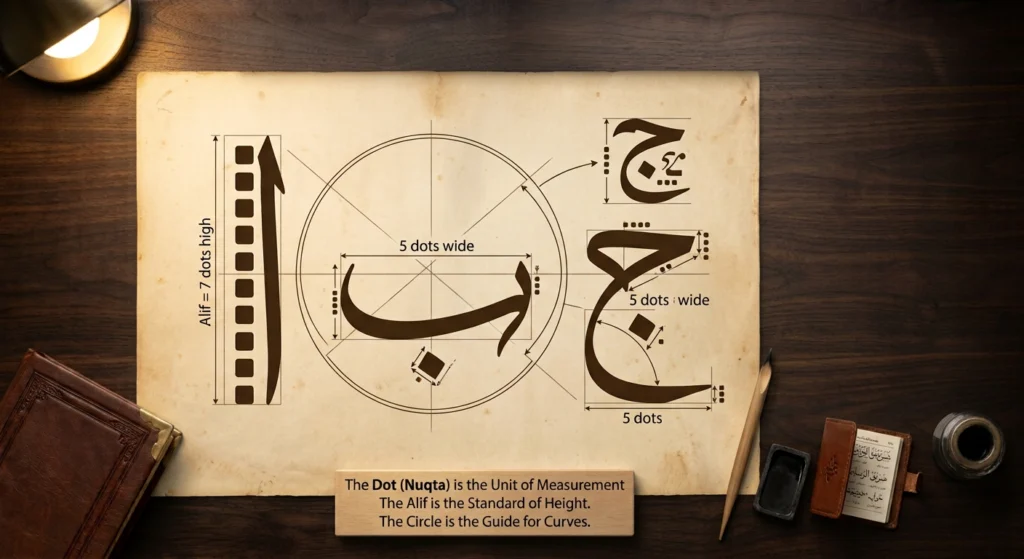
By the 10th century, scribes needed a consistent system. Ibn Muqla (d. 940), a vizier and calligrapher in Abbasid Baghdad, is credited with creating one. His method, often called “proportioned script,” used the width of the pen to make a diamond-shaped dot. A vertical alif was a set number of dots tall, and a circle with the alif as its diameter set the size of every other letter.
The idea was simple but powerful. By this method, the beauty of Calligraphy could be taught and student can easily perform it. Later tradition links Ibn Muqla with the six classical scripts known as al-aqlam al-sitta, including Thuluth and Naskh.
His successors refined the system. Ibn al-Bawwab (d. 1022) smoothed and balanced the letterforms. Yaqut al-Musta’simi (d. 1298) worked in Baghdad and is remembered for his oblique cut of the reed pen, which gave strokes a crisper and more elegant edge.
The Major Arabic Calligraphy Styles and Their Meanings
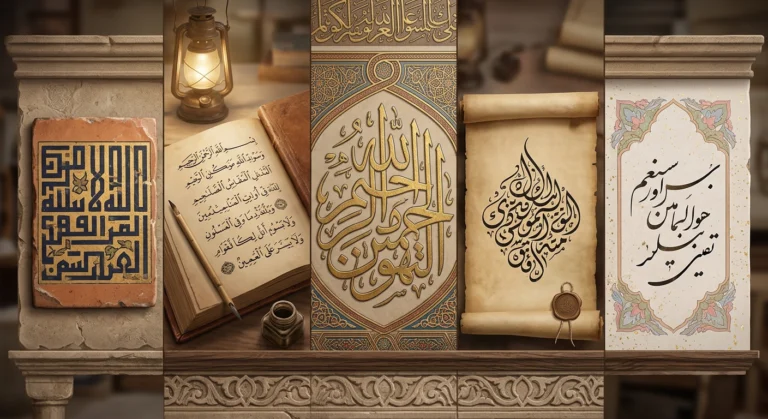
Each style grew out of a particular time, place, and purpose. Many names reflect that origin.
Kufic
The oldest of the formal styles, Kufic is geometric and monumental. It is common in early Qur’ans, on tilework, and on building facades. Modern “square Kufic” is built from right angles and can read like a maze.
Naskh
Its name comes from nasakha, “to copy.” Naskh is compact, legible, and rhythmic, which is why it became the standard for copying books and the Qur’an. It also shaped the Arabic text you read in print and on screens today.
Thuluth
It is large, curving, and dramatic, Thuluth is the showpiece style. Its name is usually translated “one-third,” though the exact reason is debated. You’ll see it on mosque domes and in the title panels of manuscripts.
Nastaliq
Developed in Persia, Nastaliq is traditionally credited to Mir Ali Tabrizi in the 14th–15th centuries. Its name suggests a blend of Naskh and Ta’liq. It has a flowing, hanging slant, and it became the favored script for Persian poetry and later, Urdu.
Diwani
Diwani emerged in the Ottoman Court of Equity in the 16th century. It is dense and swirling, with letters tucked tightly together. That was partly the point, official decrees written in Diwani were hard to alter or forge. The name comes from diwan, meaning the state council or office.
Maghribi
Developed in North Africa and Al-Andalus (Islamic Spain), Maghribi is rounded and open, with distinct regional variants. It grew from early Kufic forms and kept its own identity from the scripts used in the Middle East.
Ruq’ah
A simple, quick, everyday hand that took shape in the late Ottoman period, Ruq’ah is what many Arabic speakers use for ordinary handwriting today.
What Arabic Calligraphy Means
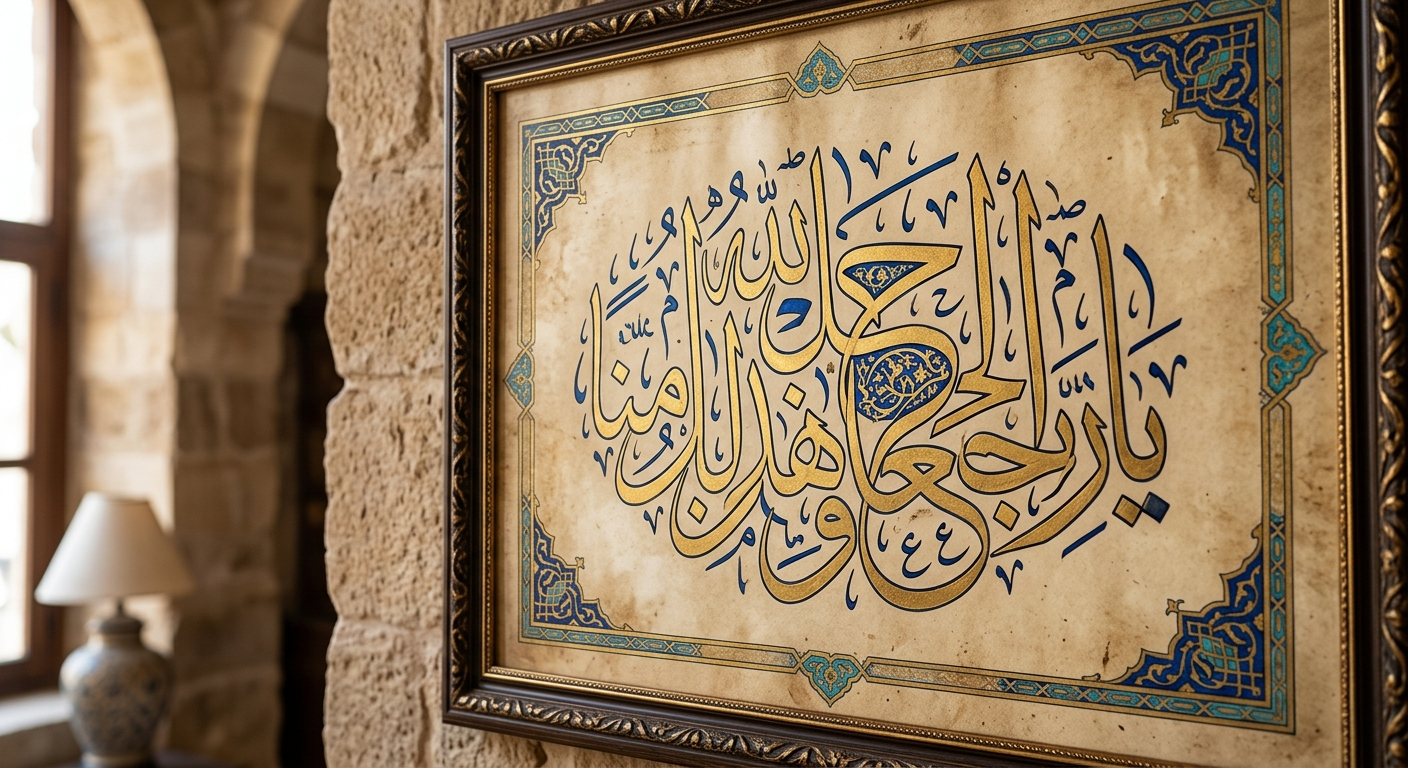
Because Arabic letters carry sacred text, beauty is treated as a form of respect. The most common subjects are the Bismilllah(“In the name of God, the Most Gracious, the Most Merciful”), Qur’anic verses, the names of God, sayings of the Prophet, and classical poetry.
Calligraphers sometimes create calligrams, where text forms a shape such as a bird, a mosque, or a ship. Even then, the writing stays readable.
Calligraphy is also a discipline. Students traditionally spent years copying a teacher’s models. A graduate received an ijaza, a certificate that placed them in a chain of teachers going back generations. The art is not limited to religious content either, and Arabic, Persian, Ottoman Turkish, and Urdu writers have all used it for secular poetry and everyday documents.
In 2021, UNESCO added Arabic calligraphy to its Representative List of the Intangible Cultural Heritage of Humanity, recognizing the knowledge and skills passed down through generations.
Tools and Training
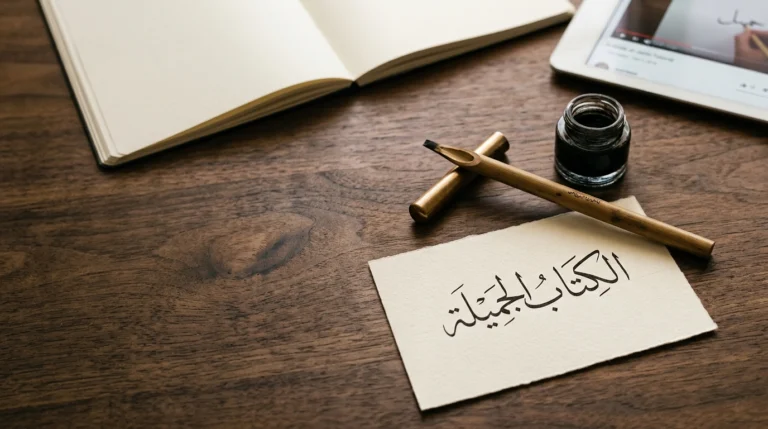
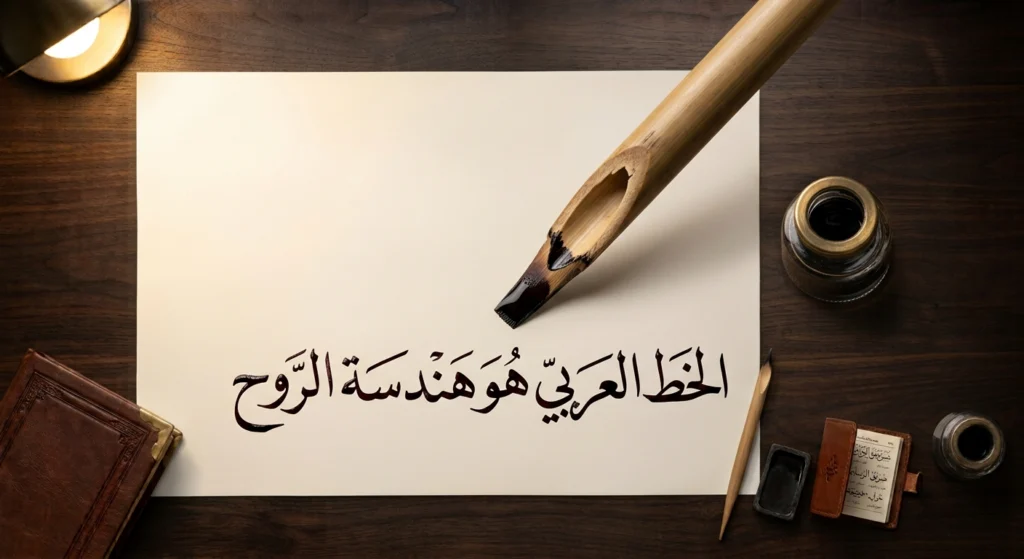
The classic toolkit is modest. A reed or bamboo pen is cut at an angle to match the style. Ink, midad, was traditionally made from soot or other natural materials. The paper was often coated and burnished until smooth, so the pen glided without bleeding. The craft depended on papermaking, which reached Baghdad by the late eighth century and made large-scale book production possible.
From Manuscripts to Digital Type
Printing, typewriters, and then computers pushed Arabic toward simpler, more uniform forms, because connected, context changing letters are hard to mechanize. Unicode and modern fonts have made Arabic far easier to display, and Naskh based typefaces became the default for screens. Contemporary artists keep the tradition moving. Tunisian French street artist eL Seed, for example, paints calligraphy across entire buildings.
In the U.S., you can see historic examples at institutions like the Metropolitan Museum of Art in New York and the Smithsonian’s National Museum of Asian Art in Washington, D.C.
How Can You Try the Styles Yourself
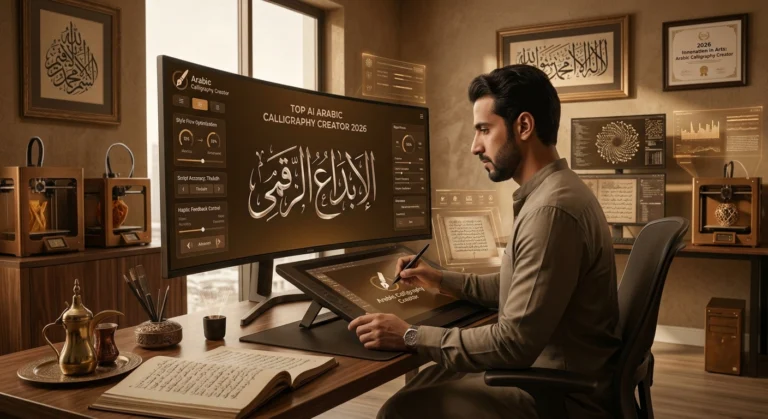
Reading about Thuluth and Nastaliq is one thing, but seeing the same word in each style makes the differences click. With Arabic Calligraphy Creator, you can type Arabic text and view it in styles including Nastaliq, Naskh, Thuluth, Diwani, Kufic, Maghribi, and Kufi Modern.
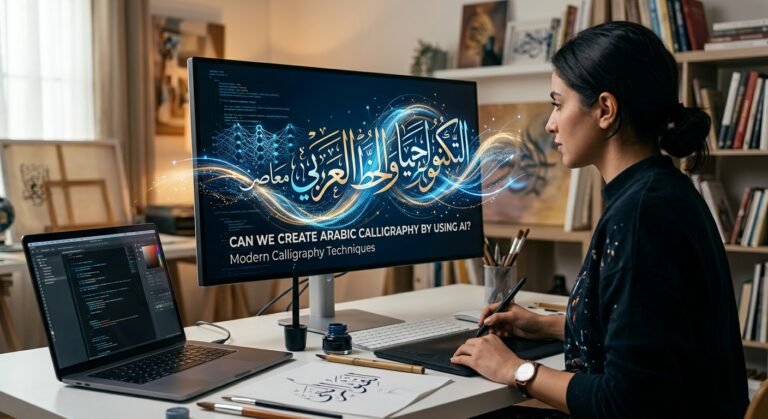
A digital font is not the same as the work of a trained calligrapher with a reed pen. It is useful, though, for comparing styles, exploring design ideas, or preparing a project. If the text is religious or headed for something permanent like a tattoo or a wall piece, have a fluent Arabic speaker check the spelling and diacritics first.
Key Takeaways
Arabic calligraphy grew from Nabataean roots into a highly refined art, driven largely by the importance of writing the Qur’an. Ibn Muqla’s proportional system gave it structure, and later masters in Baghdad, Persia, North Africa, and the Ottoman world developed distinct styles for different purposes. Today the tradition lives on in museums, mosques, street art, and design.
If you want to go further, explore Arabic calligraphy styles and see how each style handles the same words.